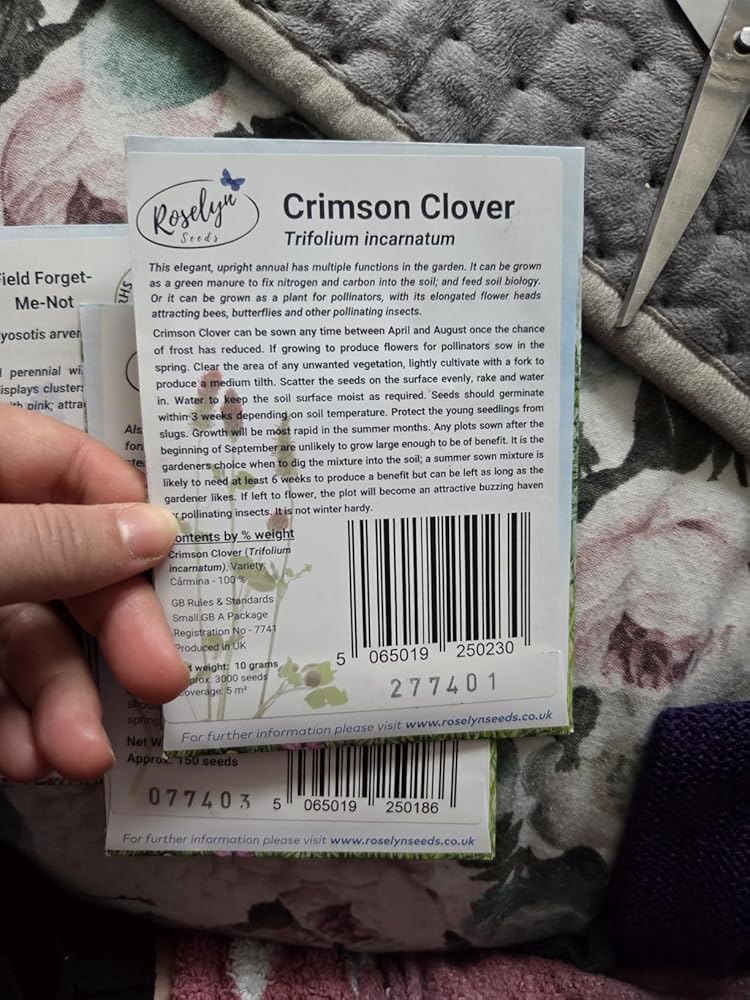
Crimson Clover Seed (Trifolium incarnatum)

Crimson Clover Seed (Trifolium incarnatum)

 Pollinators
Bumblebees
Solitary Bees
Butterflies
Moths
Honey Bees
Pollinators
Bumblebees
Solitary Bees
Butterflies
Moths
Honey Bees
Crimson Clover (Trifolium incarnatum) is an elegant upright annual that brings many benefits to the garden. It can be grown as a green manure, helping to fix nitrogen from the atmosphere and return it to the soil for future crops. As it grows it also captures carbon, feeds beneficial soil microorganisms and contributes organic matter which helps improve soil structure and fertility.
Crimson Clover is particularly valued by gardeners for its ability to naturally improve soil fertility while also supporting pollinators.
Crimson clover can also be grown as an attractive plant for pollinators. Its elongated crimson flower heads are rich in pollen and nectar and attract bees, butterflies and other pollinating insects throughout the summer.
The green manure cover crop can be dug into the soil or cut and left on the surface as a mulch, where it slowly decays and releases nutrients back into the soil for the following crop. For a dense cover crop aim to sow between 600 and 1200 seeds per square metre. Best sown between April and August. Crimson clover is not winter hardy.
Growing Instructions
-
Sow between April and August, once the risk of frost has passed.
-
If growing primarily for pollinators, sow in spring so plants have time to flower.
-
Clear the area of any unwanted vegetation and lightly cultivate the soil with a fork to produce a medium tilth.
-
Scatter the seeds evenly across the soil surface, then rake in lightly and water well.
-
Keep the soil surface moist during germination. Seeds usually germinate within three weeks, depending on soil temperature.
-
Protect young seedlings from slugs and snails.
-
Growth will be most rapid during the summer months.
-
Plots sown after early September are unlikely to grow large enough to provide much benefit as a green manure.
-
It is the gardener’s choice when to dig the crop into the soil. A summer-sown crop will usually need at least six weeks to produce enough growth to be beneficial, but it can be left longer if desired.
-
If left to flower, the plot will become an attractive buzzing haven for pollinating insects.
-
Crimson clover is not winter hardy and will usually die back after the first hard frosts
Features on the Royal Horticultural Society's Plants for Pollinators list due to its pollen and nectar producing qualities.
| Jan | Feb | Mar | Apr | May | Jun | Jul | Aug | Sep | Oct | Nov | Dec | |
|---|---|---|---|---|---|---|---|---|---|---|---|---|
| Sow as green manure | ||||||||||||
| Sow for flowers | ||||||||||||
| Flowering |